The relationship between pentraxin 3 levels and diabetic retinopathy in patients with type 2 diabetes
DOI:
https://doi.org/10.65495/eurjimr.2026.20Keywords:
diabetes mellitus, diabetic complication, diabetic retinopathy, pentraxin 3Abstract
ABSTRACT
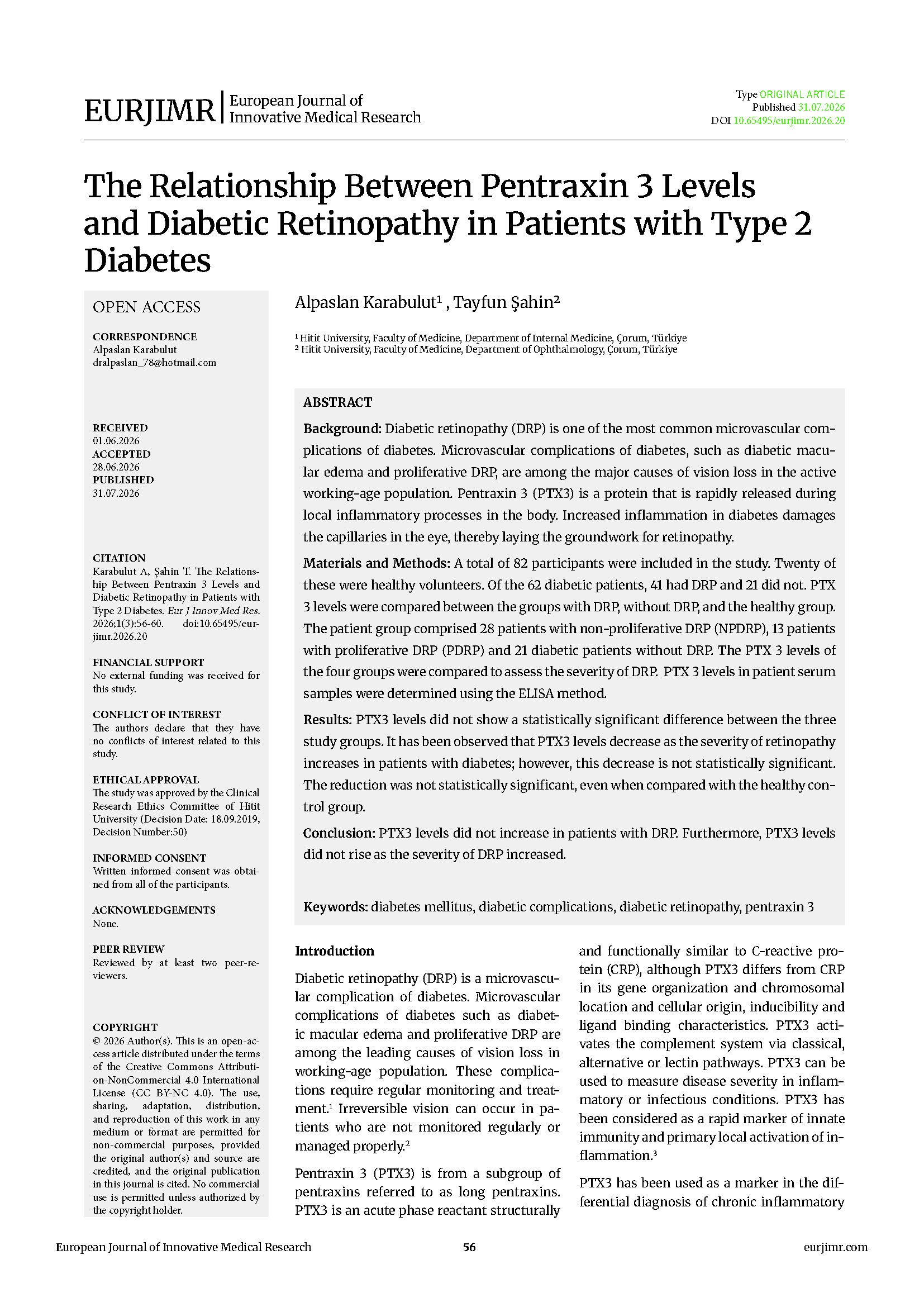
Background: Diabetic retinopathy (DRP) is one of the most common microvascular complications of diabetes. Microvascular complications of diabetes, such as diabetic macular edema and proliferative DRP, are among the major causes of vision loss in the active working-age population. Pentraxin 3 (PTX3) is a protein that is rapidly released during local inflammatory processes in the body. Increased inflammation in diabetes damages the capillaries in the eye, thereby laying the groundwork for retinopathy.
Materials and Methods: A total of 82 participants were included in the study. Twenty of these were healthy volunteers. Of the 62 diabetic patients, 41 had DRP and 21 did not. PTX 3 levels were compared between the groups with DRP, without DRP, and the healthy group. The patient group comprised 28 patients with non-proliferative DRP (NPDRP), 13 patients with proliferative DRP (PDRP) and 21 diabetic patients without DRP. The PTX 3 levels of the four groups were compared to assess the severity of DRP. PTX 3 levels in patient serum samples were determined using the ELISA method.
Results: PTX3 levels did not show a statistically significant difference between the three study groups. It has been observed that PTX3 levels decrease as the severity of retinopathy increases in patients with diabetes; however, this decrease is not statistically significant. The reduction was not statistically significant, even when compared with the healthy control group.
Conclusion: PTX3 levels did not increase in patients with DRP. Furthermore, PTX3 levels did not rise as the severity of DRP increased.
References
1. Arıkan Yorgun M, Öner S, Mendi ZN, Yıldız Taşçı Y, Toklu Y. Diyabetik Retinopati Hastalarında COVID-19 Salgını Kaynaklı Anksiyetenin Retina Kliniği Takiplerine Etkisinin Değerlendirilmesi. MN Oftalmoloji. 2023;30(2):101-106.
2. Bresnick G, Cuadros JA, Khan M, et al. Adherence to ophthalmology referral, treatment and follow-up after diabetic retinopathy screening in the primary care setting. BMJ Open Diabetes Res Care. Jun 2020;8(1)doi:10.1136/bmjdrc-2019-001154
3. Daigo K, Inforzato A, Barajon I, et al. Pentraxins in the activation and regulation of innate immunity. Immunol Rev. Nov 2016;274(1):202-217. doi:10.1111/imr.12476
4. Sharma A, Khan R, Gupta N, et al. Acute phase reactant, Pentraxin 3, as a novel marker for the diagnosis of rheumatoid arthritis. Clin Chim Acta. May 2018;480:65-70. doi:10.1016/j.cca.2018.01.035
5. Gok M, Sirkeci O, Kara M, et al. Evaluation of pentraxin-3 in familial Mediterranean fever patients during attack and attack-free periods. Bratisl Lek Listy. 2018;119(8):490-493. doi:10.4149/BLL_2018_089
6. Woo JM, Kwon MY, Shin DY, Kang YH, Hwang N, Chung SW. Human retinal pigment epithelial cells express the long pentraxin PTX3. Mol Vis. 2013;19:303-10.
7. Swinkels M, Zhang JH, Tilakaratna V, et al. C-reactive protein and pentraxin-3 binding of factor H-like protein 1 differs from complement factor H: implications for retinal inflammation. Sci Rep. Jan 26 2018;8(1):1643. doi:10.1038/s41598-017-18395-7
8. Zhou W, Hu W. Serum and Vitreous Pentraxin 3 Concentrations in Patients with Diabetic Retinopathy. Genet Test Mol Biomarkers. Mar 2016;20(3):149-53. doi:10.1089/gtmb.2015.0238
9. Yang HS, Woo JE, Lee SJ, Park SH, Woo JM. Elevated plasma pentraxin 3 levels are associated with development and progression of diabetic retinopathy in Korean patients with type 2 diabetes mellitus. Invest Ophthalmol Vis Sci. Aug 26 2014;55(9):5989-97. doi:10.1167/iovs.14-14864
10. Stravalaci M, Davi F, Parente R, et al. Control of Complement Activation by the Long Pentraxin PTX3: Implications in Age-Related Macular Degeneration. Front Pharmacol. 2020;11:591908. doi:10.3389/fphar.2020.591908
11. Haapasalo K, Meri S. Regulation of the Complement System by Pentraxins. Front Immunol. 2019;10:1750. doi:10.3389/fimmu.2019.01750
12. Mutlu M, Yuksel N, Takmaz T, Dincel AS, Bilgihan A, Altinkaynak H. Aqueous humor pentraxin-3 levels in patients with diabetes mellitus. Eye (Lond). Oct 2017;31(10):1463-1467. doi:10.1038/eye.2017.87
13. Rubsam A, Parikh S, Fort PE. Role of Inflammation in Diabetic Retinopathy. Int J Mol Sci. Mar 22 2018;19(4)doi:10.3390/ijms19040942
14. Shafabakhsh R, Aghadavod E, Mobini M, Heidari-Soureshjani R, Asemi Z. Association between microRNAs expression and signaling pathways of inflammatory markers in diabetic retinopathy. J Cell Physiol. Jun 2019;234(6):7781-7787. doi:10.1002/jcp.27685
15. Dehdashtian E, Mehrzadi S, Yousefi B, et al. Diabetic retinopathy pathogenesis and the ameliorating effects of melatonin; involvement of autophagy, inflammation and oxidative stress. Life Sci. Jan 15 2018;193:20-33. doi:10.1016/j.lfs.2017.12.001
16. Wang M, Wang Y, Xie T, et al. Prostaglandin E(2)/EP(2) receptor signalling pathway promotes diabetic retinopathy in a rat model of diabetes. Diabetologia. Feb 2019;62(2):335-348. doi:10.1007/s00125-018-4755-3
17. Porte R, Silva-Gomes R, Theroude C, et al. Regulation of inflammation and protection against invasive pneumococcal infection by the long pentraxin PTX3. Elife. May 24 2023;12doi:10.7554/eLife.78601
18. Salio M, Chimenti S, De Angelis N, et al. Cardioprotective function of the long pentraxin PTX3 in acute myocardial infarction. Circulation. Feb 26 2008;117(8):1055-64. doi:10.1161/CIRCULATIONAHA.107.749234
19. Souza DG, Amaral FA, Fagundes CT, et al. The long pentraxin PTX3 is crucial for tissue inflammation after intestinal ischemia and reperfusion in mice. Am J Pathol. Apr 2009;174(4):1309-18. doi:10.2353/ajpath.2009.080240
20. Deban L, Russo RC, Sironi M, et al. Regulation of leukocyte recruitment by the long pentraxin PTX3. Nat Immunol. Apr 2010;11(4):328-34. doi:10.1038/ni.1854
21. Stravalaci M, Ferrara M, Pathak V, et al. The Long Pentraxin PTX3 as a New Biomarker and Pharmacological Target in Age-Related Macular Degeneration and Diabetic Retinopathy. Front Pharmacol. 2021;12:811344. doi:10.3389/fphar.2021.811344
22. Dobriceanu RC, Meca AD, Boboc IKS, et al. Pentraxin-3 as a Biomarker in Diabetes Mellitus: Insights into Inflammation, Vascular Complications, and Modulation by Antidiabetic Medications. Biomedicines. Apr 7 2025;13(4)doi:10.3390/biomedicines13040891
23. Mohammadpour Fard R, Sherafat NS, Rashno M, Bahreiny SS. Evaluating pentraxin 3 as a diagnostic biomarker for diabetic retinopathy: a systematic review and meta-analysis. Diabetol Metab Syndr. Jul 16 2025;17(1):273. doi:10.1186/s13098-025-01849-8
24. Porte R, Davoudian S, Asgari F, et al. The Long Pentraxin PTX3 as a Humoral Innate Immunity Functional Player and Biomarker of Infections and Sepsis. Front Immunol. 2019;10:794. doi:10.3389/fimmu.2019.00794
25. Jiang Y, Xing X, Niu T, et al. Protective effect of pentraxin 3 on pathological retinal angiogenesis in an in vitro model of diabetic retinopathy. Arch Biochem Biophys. Aug 15 2022;725:109283. doi:10.1016/j.abb.2022.109283
26. Rodrigues PF, Matarazzo S, Maccarinelli F, et al. Long Pentraxin 3-Mediated Fibroblast Growth Factor Trapping Impairs Fibrosarcoma Growth. Front Oncol. 2018;8:472. doi:10.3389/fonc.2018.00472
Downloads
Published
Data Availability Statement
Written informed consent was obtained from all individual participants included in this prospective study. All participants were fully informed about the study’s objectives, procedures, potential risks, and benefits, and their voluntary participation was ensured.The author(s) have made their research data accessible.
License
Copyright (c) 2026 Alpaslan Karabulut, Tayfun Şahin (Author)

This work is licensed under a Creative Commons Attribution-NonCommercial 4.0 International License.